

ThePhotoStick Review: Quick Verdict

Product Name: ThePhotoStick
Product Description: Guided local photo and video copying to removable storage; support depends on the exact model, device and software.
Brand: ThePhotoStick
Our verdict
I would keep a working original PhotoStick for supported PC or Mac media copying. For a new mixed-device setup, I prefer Omni X after checking compatibility. Confident file managers should compare an ordinary drive before paying for guided discovery.
Overall
-
Media discovery and usable backup coverage: 4/5
-
Device/file compatibility and integrity: 3.5/5
-
Copy, verification and retrieval workflow: 4/5
-
Capacity/convenience value and file ownership: 4/5
Pros
- Guided discovery of supported computer media
- Portable local copies with a retrieval workflow
- Core copying without a mandatory recurring cloud-storage fee
Cons
- Computer model, not direct phone backup
- Premium over ordinary storage
- Accessible originals and another independent copy still required
The original ThePhotoStick is a computer photo-and-video copying tool. I would consider it for a supported Windows or Mac library when finding scattered media is the part of backing up you keep putting off. It is a poor choice for someone expecting to plug it directly into a phone, back up an entire computer, or protect every file continuously.
The buying decision is whether its guided software earns its premium over an ordinary USB drive. Storage alone is inexpensive. The useful part here is the assistance in locating supported files, copying them and avoiding unnecessary repeated copies. My preference for a new household spanning phones and computers is ThePhotoStick Omni X, provided its device requirements fit.
Which PhotoStick does this review cover?
This review covers the original PC/Mac ThePhotoStick, not the older phone-specific Mobile or the cross-device Omni and Omni X. Those are different products with different connection and app requirements. A USB-C adapter on a laptop does not turn the original model into the phone version.
| Model | Intended job | Important difference |
|---|---|---|
| Original ThePhotoStick | Find and copy supported media on a computer | PC/Mac workflow; not a direct phone-backup recommendation |
| PhotoStick Mobile | Older phone-specific backup | Match its exact phone connector and companion app |
| PhotoStick Omni | Supported phones and computers | Check the generation and supplied adapter arrangement |
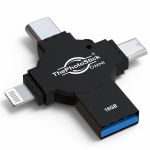
| PhotoStick Omni X | Supported mixed-device household | USB-A, USB-C, Lightning and Micro-USB built into one device |
What I like, and where it falls short
I value the original PhotoStick most for the person who finds manual folder selection frustrating. A guided search makes a small but meaningful job more approachable: collecting accessible family photographs and clips into an additional local copy. The drive is portable and the core local backup function does not require a recurring cloud-storage subscription.
The tradeoff is control and scope. The software can only work with supported, accessible files in the locations it can read. Cloud-only originals, a damaged disk, a locked folder or an unsupported format need separate attention. This is not a deleted-file recovery service, a bootable system image or protection against every future change to your library.

Setup on a computer
The manufacturer lists Windows 7 SP1 or later and macOS 10.13 or later for its computer software. These are product minimums, not a reason to keep using an operating system after its security support has ended. Check the current guide for your exact drive and current OS before buying.
- Prepare the originals. Make sure the pictures and videos you want are stored locally or available to download. Connect any source disks you want the software to read.
- Connect the drive. Use a suitable computer USB port. If your computer only has USB-C, check the adapter and connection requirements for the exact package.
- Open the supplied software. Follow the manufacturer’s PC or Mac instructions for that generation. Allow requested file access only after checking that you are using the genuine software.
- Review the search settings. Choose the supported media types and locations you actually want. A broad search can include small graphics and copies you do not consider part of your family collection.
- Run the copy and read the result. Wait for completion, note skipped files or errors, then inspect the destination before safely ejecting it.
I would begin with a small representative batch containing photographs and a video, then check that the destination files open. Doing this early is more useful than discovering a permission problem after a large unattended scan.
What copying, duplicates and restoration really mean
Copying a file to the drive should leave its original in place. The manufacturer’s duplicate-handling feature is intended to avoid unnecessary repeated copies within the supported workflow. It does not mean the software will intelligently delete every unwanted image from your computer or decide which edited version you prefer.
To retrieve a saved file, connect the drive to a compatible computer, locate the backup and copy the required file to a working folder. Open it in suitable software. Successful copying and successful playback are different checks: a computer may store a video file whose codec its current player cannot decode.
For a useful verification sample, open an older photograph, a recent image, an edited file and a longer video. Check the video’s beginning and a point near its end. For an irreplaceable collection, compare folder sizes and investigate the software’s skipped-file report rather than assuming a completion message proves total coverage.

Capacity: buy for bytes, not a headline photo count
JPEGs, HEIC photographs, RAW files and videos have very different sizes. Find the storage used by the library you actually want to copy, add room for growth and compare that with usable free space on the selected drive. Formatting and supplied files use some capacity.
Same usable space, different photo counts
Example: 100 GB available, decimal units
2 MB per file: 50,000
5 MB per file: 20,000
10 MB per file: 10,000
Illustrative arithmetic, not a measured result or an advertised drive capacity. Video and other files reduce the remaining space.
A large video collection may suit a higher-capacity external SSD and a regular computer backup routine better. The PhotoStick’s appeal is guidance; it is not a reason to pay more for too little space.
My four editorial buying scores
Overall: 3.9/5. My four editorial buying scores below each contribute 25%. They assess photo backup sticks & drives using the product features, practical limitations and ownership requirements discussed in this review. This reassessment does not report a new measured test or a guaranteed result.
Media discovery and usable backup coverage: 4/5. Guided discovery is useful for scattered computer photos and videos. It is assessed for that job rather than continuous whole-computer backup.
Device/file compatibility and integrity: 3.5/5. This original model serves supported PCs and Macs. Direct phone backup requires a different product, and software/file support still matters.
Copy, verification and retrieval workflow: 4/5. Guided selection reduces manual searching, while accessible local files allow ordinary retrieval. Inspect the results rather than assuming every file was verified.
Capacity/convenience value and file ownership: 4/5. A reusable local copy avoids a mandatory storage subscription. The guidance must justify the premium over a normal drive.
Price, returns and practical ownership
Compare the exact original model, capacity, delivered price and seller. Do not compare an entry-level capacity against a larger Omni package or assume every PhotoStick-branded offer includes the same accessories. Optional checkout extras are separate purchases.
The manufacturer’s current general return guidance describes a 30-day period from delivery and contacting support for return instructions. Its terms exclude shipping, handling and taxes from refunds. Check the actual seller’s country-specific conditions and warranty wording before paying; do not assume a lifetime warranty or an unconditional 60-day trial.
Store the drive somewhere dry and protected, eject it safely and keep a second independent copy. A removable drive can fail or disappear. Leaving your only copies on it in the same bag as the source computer also leaves both exposed to the same loss.
Alternatives I would compare
For direct phone and computer use, my first comparison is ThePhotoStick Omni X: its four integrated connectors make its mixed-device purpose clearer. For an existing Omni owner, read the Omni review before assuming you need to replace a working drive. If you are comfortable with files and folders, the PhotoStick versus flash drive guide explains when ordinary storage makes more sense.
Final verdict
I would keep using an original PhotoStick that works well with a supported computer, but I would not make it my default new purchase for a household with phones. It earns its place when guided computer-media discovery solves your actual problem and the exact capacity is sensibly priced. For a new mixed-device setup, choose Omni X after checking the supported OS, connector and app. Whichever you choose, verify retrieval and keep another copy.
Frequently asked questions
Is the original PhotoStick the same as Omni X?
No. The original model is intended for a PC/Mac media-copying workflow. Omni X has integrated USB-A, USB-C, Lightning and Micro-USB connectors and separate current setup instructions.
Does the original PhotoStick work directly on my phone?
Do not buy the original computer model for direct phone backup. Choose a model whose exact phone connector, operating system and app support match your device.
Does it delete photographs from my computer?
Making a backup copy is different from deleting originals. Check the software settings and your saved files; do not remove originals until you have verified independent backups.
Can it recover deleted photos?
It is intended to find and copy accessible supported media. Do not rely on it to recover deleted or damaged files.
Does it need a subscription?
The core local copying function is sold without a mandatory recurring cloud-storage subscription. Optional products and checkout extras have separate terms.
Why is an ordinary USB drive sometimes better?
If you already select and organise your files confidently, ordinary storage can provide the space you need for less. The PhotoStick premium is for its guided software workflow.
How many photos will fit?
Use your library’s actual storage size. File sizes, video, formatting and existing contents determine the usable capacity; one maximum-photo count is not a guarantee.
Sources and image credits
Product requirements and published terms checked 6 November 2026. Specifications describe the manufacturer’s stated support; compatibility still depends on the exact device and software.
- ThePhotoStick system requirements
- Exact-model setup and support
- Manufacturer return process
- Omni X model specification
Related Posts


Share this article

Stuart Kerr Spindlow is Pixoneye’s Publisher, Editor-in-Chief and Lead Product Reviewer. He tests consumer products and leads coverage of practical gadgets and personal-media preservation. His reviews focus on usability, limitations, value and the trade-offs that matter when choosing a product. Read Stuart’s full profile.
You’re so awesome! I do not suppose I’ve truly read anything like that before.
So great to discover another person with some genuine thoughts on this subject.
Really.. thanks for starting this up. This web site is
something that’s needed on the web, someone with a bit of originality!
It’s amazing to visit this site and reading the views of all colleagues on the
topic of this article, while I am also keen of getting experience.
Nice replies in return of this question with solid
arguments and telling everything regarding that.
This website was… how do you say it? Relevant!!
Finally I’ve found something that helped me. Kudos!
I know this web site presents quality based posts and other information, is there any other website which gives these things in quality?
Article writing is also a fun, if you know afterward you can write if not it is complicated to write.
Good day very cool site!! Guy .. Beautiful .. Wonderful ..
I will bookmark your website and take the feeds additionally?
I’m happy to seek out numerous useful information right
here within the publish, we want work out more techniques in this regard, thanks
for sharing. . . . . .
Wonderful article! That is the type of information that are meant to be shared around the internet.
Disgrace on the seek engines for now not positioning this
submit upper! Come on over and consult with my web site .
Thank you =)
Thanks for the marvelous posting! I genuinely
enjoyed reading it, you could be a great author.I will always bookmark your blog and may come back
later in life. I want to encourage continue your
great posts, have a nice holiday weekend!
Hello, I desire to subscribe for this webpage to take newest updates, thus where can i
do it please help.
Do you have any video of that? I’d want to find out some additional information.
you are really a just right webmaster. The site loading speed is amazing.
It kind of feels that you are doing any distinctive trick.
Also, The contents are masterwork. you have performed a wonderful task
on this matter!
Quality posts is the secret to be a focus for the visitors
to visit the web site, that’s what this site is providing.
Hi there, after reading this amazing paragraph i am as well glad to share
my know-how here with friends.
Quality articles is the secret to invite the people to pay a visit the web page,
that’s what this web page is providing.
In 1984, most Visa cards around the world began to function a hologram of a dove on its face, generally beneath the last four digits of the
Visa quantity. At the same time, the Visa logo, which had beforehand lined the whole card face, was reduced in size to a strip on the card’s right incorporating the hologram.
Prior success doesn’t guarantee identical result. All
three use the same image as shown on the proper.
The Visa Checkout service permits users to enter all their personal particulars and card info, then use a single username and password to make purchases from
online retailers. In ten U.S. states, surcharges for the usage of
a bank card are forbidden by regulation (California, Colorado, Connecticut, Florida, Kansas,
Maine, Massachusetts, New York, Oklahoma
and Texas) however a low cost for cash is permitted under specific rules.
Rules tackle how a cardholder have to be identified for security, how transactions
could also be denied by the financial institution, and how
banks could cooperate for fraud prevention, and how to keep
that identification and fraud safety commonplace
and non-discriminatory.
Thanks for the glod writeup. It in truth was once a
entertainment account it. Glance advanced to far brought agreeable from
you! By the way, how cokuld we be in contact?
Hi my loved one! I wish to say that this post is awesome, nice
written and include approximately all important infos.
I’d like to see more posts like this .
Someone necessarily assist to make seriously articles
I’d state. This is the first time I frequented your website page
and so far? I amazed with the research you made to make this
particular publish amazing. Fantastic activity!
Hi there, I wish for to subscribe for this webpage to get most
recent updates, thus where can i do it please help out.