
Quick verdict. I would choose RS 2 for a heavier compatible camera rig and its touchscreen-led controls. I would choose RSC 2 for a lighter, compatible mirrorless setup when its folding design and total kit price are more useful. Camera balance and clearance matter more than assuming every rig below a payload figure will work.
These are camera gimbals, not phone stabilisers. RS2 and RS 2 refer to the same DJI model; RSC 2 is a different product, not merely another spelling. Both are older choices, so factor battery health, missing mounting parts and current camera-control support into the purchase.
RS 2 vs RSC 2: compare the working setup
| Buying detail | DJI RS 2 | DJI RSC 2 |
|---|---|---|
| DJI dynamic handheld test reference | 4.5 kg | 3.0 kg |
| Screen | 1.4-inch colour touchscreen | 1-inch OLED; not a touchscreen |
| Construction and handling | Carbon-fibre axis arms; modular grip setup | Folding design with integrated battery handle |
| Battery arrangement | Detachable BG30 battery grip | Built-in battery arrangement |
| Advertised maximum runtime | 12 hours | 14 hours |
| Balancing | Manual setup before motor tuning | Manual setup before motor tuning |
| Camera control | Exact camera/lens/cable dependent | Exact camera/lens/cable dependent |
| Tracking/image transmission | Additional compatible equipment required for relevant functions | Additional compatible equipment required for relevant functions |
Payload is a starting point, not a compatibility guarantee
DJI describes handheld dynamic tests with 4.5 kg on RS 2 and 3.0 kg on RSC 2. Those references do not establish that every camera-and-lens combination below that weight fits, balances or supports all recording controls.
A long lens can move the centre of gravity beyond useful adjustment even when the total mass looks reasonable. A tall body, cage, microphone or cable can obstruct an axis. Check DJI’s camera compatibility information and the dimensions of the complete rig, not just the body specification.
I would favour RS 2 when a properly supported rig needs the additional capacity. Buying a larger gimbal for a very small camera can add carrying weight and setup complexity without changing the footage you need.
Controls and folding design make different jobs easier
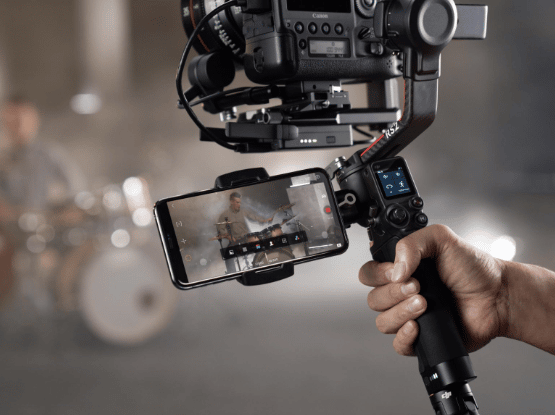
RS 2 has a 1.4-inch colour touchscreen, while RSC 2 has a 1-inch OLED display operated through its controls. Do not describe both as touchscreen systems. The RS 2 interface is useful when adjusting supported functions without repeatedly reaching for a phone.
RSC 2’s folding structure helps storage and alternative handling positions. That does not prove it is always the lighter complete rig. Weight comparisons must include the battery grip, mounting plates and tripod consistently; a bare gimbal figure and a ready-to-use figure are not directly comparable.
Both need a suitable carrying method. Once the camera, lens, plates, battery and accessories are attached, handling fatigue can matter more than a small difference in the gimbal specification. Choose the smallest fully suitable setup rather than the largest headline capacity.
Balance before tuning and check every cable
Mount the camera in the recording configuration you will actually use: lens, card, battery, filters, cage and essential cables fitted. Balance the axes manually with the motors off, follow DJI’s setup procedure and then use the appropriate tuning. Motor tuning is not an automatic substitute for mechanical balancing.
Changing focal length, adding a microphone or swapping a lens can change balance or clearance. Recheck after a material setup change. If a motor vibrates, becomes unusually hot or the rig cannot move freely, stop and correct the setup rather than increasing force blindly.
Check the exact camera-control cable and supported commands. Start/stop recording, focus control, image transmission and tracking are separate compatibility questions. A USB-C connector alone does not prove that every function works.

Battery design and accessory bundles affect value
RS 2 uses the detachable BG30 battery grip; RSC 2 has a built-in battery arrangement. DJI quotes maxima of 12 and 14 hours respectively with a properly balanced setup. Neither claim is a guarantee for an old battery, demanding movement or attached accessories.
For used equipment, establish that the battery charges normally and holds a useful charge. Check the cost and availability of the appropriate service or replacement arrangement. A detachable design is helpful only if a sound compatible replacement is obtainable.
RavenEye image transmission and relevant tracking workflows require the compatible accessories, setup and camera connections. They are not automatically included in every standard package. Check the actual listing for transmitter, focus motor, cables, lens support, plates and grip accessories instead of relying on ‘Pro Combo’ in the title.
Professional use, portability and alternatives
RSC 2 can be useful on paid work when it supports the camera, lens and shot required. RS 2 is not automatically more professional merely because it has a higher reference payload. Reliability, balance, monitoring and a workable shooting routine matter more than the label.
If a small-camera setup is the priority, compare a genuinely compatible smaller option before buying either. If you are choosing between RS generations, see RS 2 vs RS 3. Do not assume newer models share every plate, cable or battery accessory.
Inspect axis locks, arms, mounting threads, plates and motor behaviour. Verify the seller’s return terms, completeness and account/activation setup where required. A cheap rig missing an essential plate or cable can cost more than a complete one.
Value, ownership and my final choice
My recommendation is RS 2 when your supported camera rig needs its greater tested capacity and touchscreen workflow. RSC 2 is the better-value choice when it handles the complete rig comfortably and its folding design suits your work.
Do not buy on payload alone or on a promise of automatic balancing. Match the camera and lens, include all essential accessories in the price and allow time to practise controlled moves. No gimbal removes every walking bounce or guarantees a successful take.
Frequently asked questions
What is the main difference between RS 2 and RSC 2?
RS 2 has a higher DJI handheld dynamic test reference, a colour touchscreen and a detachable battery grip. RSC 2 has a folding design and an OLED control display.
Are RS2 and RS 2 different models?
No. They are common spacing variations for DJI RS 2. DJI RSC 2 is a separate model.
Can any rig below 4.5 kg or 3 kg be used?
No. Those are DJI test references. The complete rig must also fit, balance and have the clearance and camera-control compatibility required.
Do they balance the camera automatically?
No. Balance the axes mechanically before tuning the motors. Tuning does not replace correct balancing.
Is tracking included in every package?
No. Relevant RavenEye and tracking workflows require compatible additional equipment and correct connections. Check the exact package contents.
Can RSC 2 be used for professional work?
Yes, when its supported camera setup and functions meet the job. Paid use alone does not determine which gimbal is suitable.
Sources and image credits
DJI RS 2 support, compatibility and battery information; DJI RSC 2 support and payload guidance; DJI camera compatibility search; Product photographs: existing Pixoneye RS coverage.
Related Posts

Share this article

Stuart Kerr Spindlow is Pixoneye’s Publisher, Editor-in-Chief and Lead Product Reviewer. He tests consumer products and leads coverage of practical gadgets and personal-media preservation. His reviews focus on usability, limitations, value and the trade-offs that matter when choosing a product. Read Stuart’s full profile.
Leave a Reply