
TL;DR: My preference is Aerobika when a suitable OPEP device needs clear resistance adjustment and flexible positioning. Its five settings are the decisive practical advantage. AirPhysio remains an option when its ball mechanism, model and tilt suit the user. If a clinician has recommended a particular device, that individual recommendation takes priority.
I would choose an airway-clearance device by fit with a care plan, adjustment and the routine it requires. AirPhysio and Aerobika both use oscillating positive expiratory pressure, but their controls and positioning differ.
The differences that matter
| Buying factor | AirPhysio | Aerobika |
|---|---|---|
| Function | OPEP airway clearance | OPEP airway clearance |
| Mechanism | Steel ball oscillates in a cone during exhalation | Internal pressure-oscillation mechanism |
| Adjustment | Correct model/ball and tilt matter | Five selectable resistance settings |
| Position | Guide calls for adjusting tilt | Designed for different positions |
| Power | No battery needed | No battery needed |
| My buyer fit | A user whose plan suits the ball device and its technique | A user whose plan benefits from clearer adjustment and positioning flexibility |
AirPhysio: understand the ball and angle

AirPhysio’s device description identifies a steel ball, cone, protective cover and mouthpiece. The current user guide explains technique and adjusting the tilt. Different ball sizes and versions exist, so the exact model matters.
I value the simplicity of a device without batteries or charging. The trade-off is that correct technique is part of the product, not an optional extra. A user who finds the angle difficult to maintain may find another design more practical. I would ask for a demonstration of the prescribed technique rather than buy by a generic lung-strength promise.
Keep the removable parts together and away from children. Do not substitute a different ball or alter the device to obtain more resistance. Check the manual supplied with the exact version, including how its protective cap opens.
Aerobika: clearer adjustment and positioning
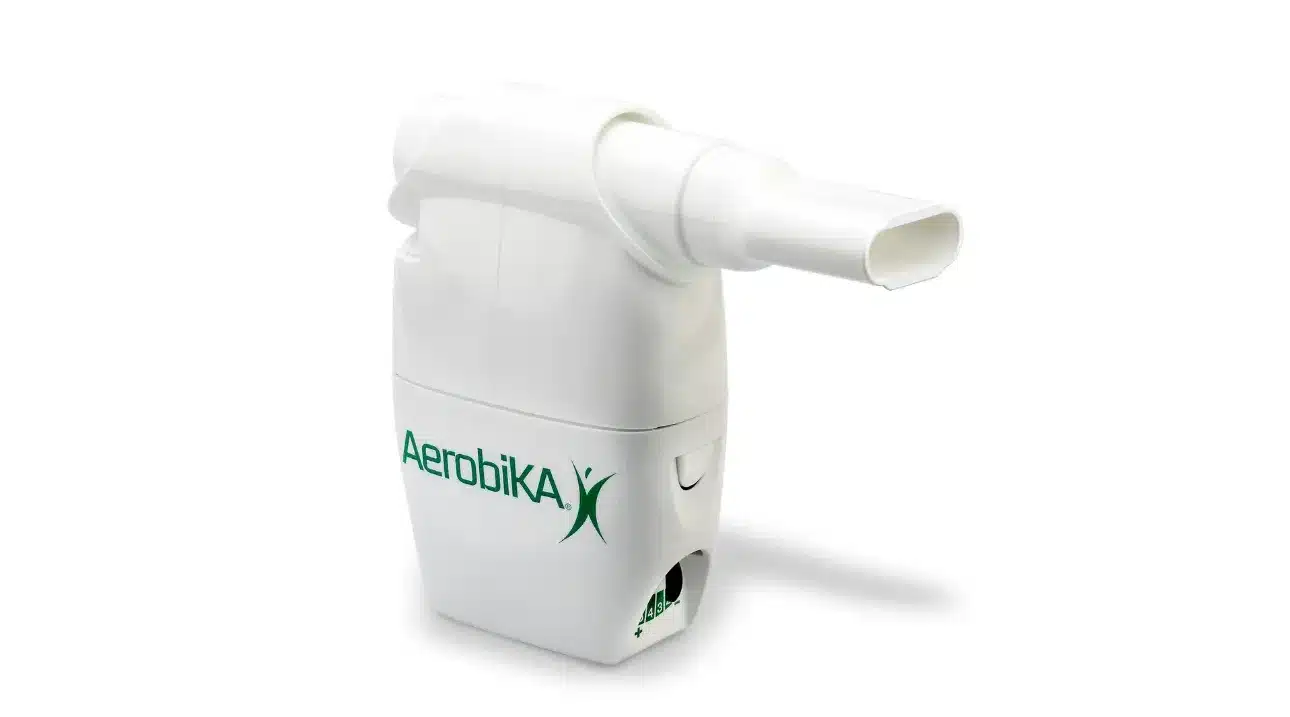
Trudell’s Aerobika product page identifies five resistance settings and use in multiple positions. I prefer that combination when a routine requires identifiable settings or positioning flexibility. The setting should follow the individual plan, rather than an assumption that the highest number is best.
That convenience does not make it suitable for everyone. Mouthpiece comfort, exhalation technique and cleaning still matter. Nor does the nebulizer connection mean every nebulizer and medication can be combined with it. Use that feature only with compatible equipment and professional instructions.
Cleaning and long-term ownership
Use each device’s own cleaning instructions. AirPhysio’s guide calls for disassembly and cleaning after sessions. Trudell provides a separate Aerobika cleaning guide. Do not transfer an alcohol, boiling or dishwasher procedure from one device to the other.
I would make drying and clean storage part of the buying decision. Keep the device for one user, check that all parts are reassembled correctly and replace damaged parts through the appropriate supplier. A cracked or incorrectly assembled device should not be treated as equivalent to a working one.
Trudell’s product guidance recommends replacing Aerobika after 12 months or sooner if damaged. Local supply arrangements and the instructions delivered with the device should guide replacement. I would budget for ownership, not just the first purchase.
Safety and the limits of the comparison
OPEP is an airway-clearance function. It is different from simply buying a breathing-muscle trainer, and it should not replace prescribed medication or assessment of breathlessness. Sudden or severe breathing difficulty needs urgent medical attention rather than a new device order.
Both manufacturers list contraindications. AirPhysio’s warnings include untreated pneumothorax, tuberculosis, oesophageal surgery, right-sided heart failure and middle-ear problems. Aerobika’s instructions for use also identify situations such as bleeding, recent surgery, instability and inability to tolerate the extra work of breathing. A respiratory professional should check suitability and technique.
I would not call either a guaranteed treatment for asthma, COPD or another disease, or infer that drug-free means risk-free. The most useful device is the one appropriate for the person and used correctly. An apparent improvement in comfort should not prompt an unsupervised change to treatment.
Price, seller and supply route
Compare the exact version, included parts, replacement needs and local delivery. Prices and supply routes vary by country and seller; I would not combine an Australian AirPhysio offer with an assumed UK or US Aerobika price.
Check whether an opened respiratory device can be returned, how a defect is handled and which supplier provides support. An official manufacturer page or approved merchant is preferable to an unidentified marketplace listing. Keep the receipt and exact product information.
For muscle-training needs, our The Breather vs POWERbreathe comparison explains that separate category. If you want more context on the ball device, read our AirPhysio review, then use the current exact-model instructions for your order.
Final verdict
Aerobika is my conditional preference for adjustment and positioning flexibility. AirPhysio’s simple ball design can make sense when it matches the user’s plan and technique. I would choose professional suitability and a sustainable cleaning routine ahead of a discount, an unsupported clinical ranking or a promise of bigger lungs.
Frequently asked questions
How do AirPhysio and Aerobika compare in terms of effectiveness for lung expansion?
Both are OPEP airway-clearance devices. I would not select either on a claim that it universally expands lungs more. Choose the device, resistance and technique that a respiratory professional considers suitable for your airway-clearance needs.
What are the differences in the mechanism of action between AirPhysio and Aerobika?
AirPhysio’s manufacturer describes a steel ball and cone that oscillate during exhalation; its guide calls for adjusting the tilt. Aerobika uses an internal oscillating mechanism with five selectable resistance settings and is designed for use in different positions.
Which device, AirPhysio or Aerobika, do healthcare professionals recommend more?
There is no universal recommendation for every patient. Follow the professional who knows your condition and can check technique. My buying preference for Aerobika’s adjustment and positioning flexibility is a usability judgement, not a recommendation to change an existing care plan.
Are there any side effects associated with the long-term use of AirPhysio or Aerobika?
Both manufacturers list contraindications. Do not assume long-term use is safe for every person. Relevant concerns include untreated collapsed lung, bleeding, recent surgery and ear problems. Stop if you become unwell and seek appropriate advice; obtain professional guidance before starting with a medical condition.
How do these devices differ in their ease of use for patients with respiratory conditions?
Aerobika’s five settings and positioning flexibility can simplify adjustment within a prescribed plan. AirPhysio requires the appropriate model and an effective tilt for its ball mechanism. Cleaning, mouthpiece fit and the ability to use the correct exhalation technique also affect practicality.
What is the expected duration of use for AirPhysio vs Aerobika during respiratory therapy sessions?
Use the schedule in your own instructions and clinician’s plan. There is no single session length that applies to both devices, every condition or every resistance setting. Do not copy a generic five-minute or ten-minute routine from a product comparison.
Sources and image credits
Aerobika OPEP device and resistance selector. Image: Trudell.

Share this article

Stuart Kerr Spindlow is Pixoneye’s Publisher, Editor-in-Chief and Lead Product Reviewer. He tests consumer products and leads coverage of practical gadgets and personal-media preservation. His reviews focus on usability, limitations, value and the trade-offs that matter when choosing a product. Read Stuart’s full profile.
Leave a Reply