
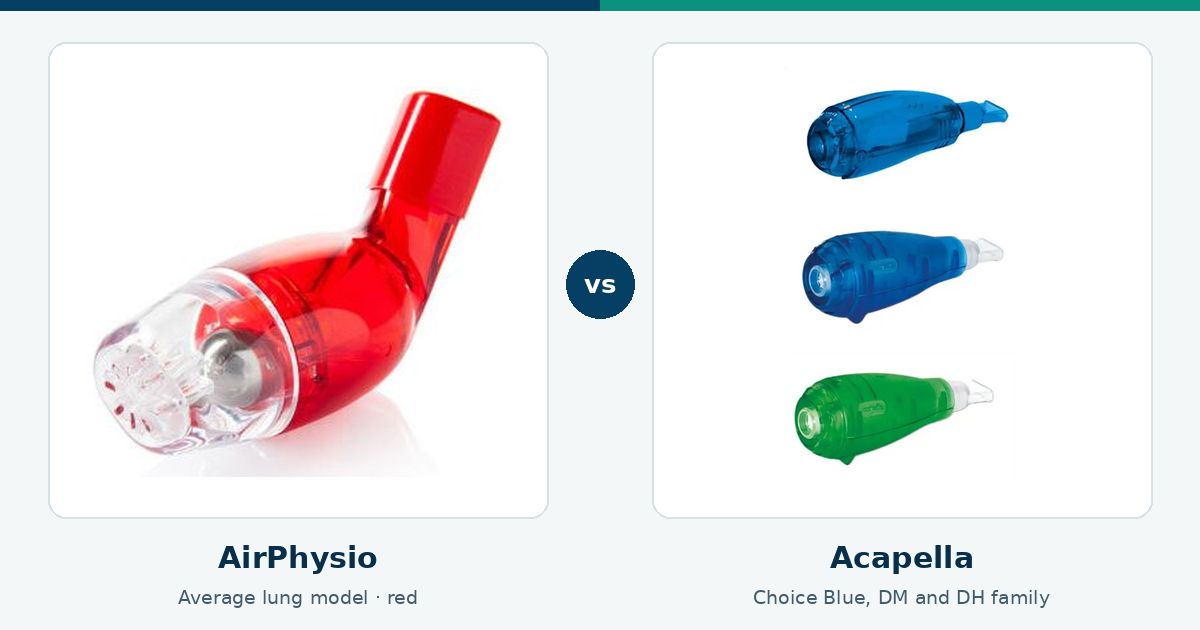
AirPhysio vs Acapella: Quick Verdict. Choose AirPhysio for a simple, portable OPEP device when its ball and position suit your prescribed airway-clearance routine. Choose Acapella Choice Blue when its opening body and cleaning access matter most; legacy DM and DH also offer resistance adjustment and position flexibility. My overall buying preference is Choice Blue for that flexibility; the right model and technique matter more than a brand-wide winner.
AirPhysio and Acapella both use oscillating positive expiratory pressure, or OPEP: you breathe out against resistance while the device generates vibrations. That shared purpose makes this a useful comparison, but the designs are not interchangeable. “Acapella” names a family of devices, not one universal model, and an AirPhysio ball needs to suit the person using it.
For this AirPhysio vs Acapella comparison, I put model fit, daily handling, cleaning and purchase cost ahead of promises about “stronger lungs”. An OPEP device can form part of an airway-clearance plan; it does not replace prescribed medicines, an inhaler, a nebuliser or sleep-apnoea treatment. Ask your respiratory clinician which device and routine are appropriate before buying.
AirPhysio: a simple ball-and-cone design

AirPhysio uses a steel ball sitting on a cone inside the body. Exhaled air moves the ball and creates the oscillating resistance. There is no battery, charging lead or powered pump to manage. It is a compact option for someone who wants a device they can carry and keep with their other daily equipment.
The practical limitation is positioning. The ball responds to airflow and the way the device is held, so the useful angle is part of the technique, not a cosmetic detail. A ball that is too demanding for the user is not an upgrade. AirPhysio’s user guide distinguishes lower-resistance balls for people who need them from the regular ball used by other users.
I like the straightforward portable format for personal use. Its appeal is low setup overhead rather than a guaranteed respiratory result. For the fuller assessment of the same design, see my AirPhysio review.
Acapella: choose the generation as well as the colour

The green legacy Acapella pictured here is different from the newer Acapella Choice Blue. When shopping, read the complete model name and the supplied instructions. A retailer’s generic “Acapella breathing device” description does not tell you which generation, resistance range or cleaning method is in the box.
Legacy Acapella DM is the blue lower-flow model; legacy DH is the green higher-flow model. Choice Blue is a separate design, so its blue housing does not mean it is simply a renamed DM. This distinction matters when replacing a device or comparing a photograph with a clinician’s recommendation.
ICU Medical’s Choice Blue brochure describes adjustable resistance and use in different positions. That is useful if maintaining one ball-device angle is awkward. Choice Blue can also open fully for cleaning. These are design advantages, not evidence that every user will clear more mucus with it.
The model decision in one view
Lower-flow legacy model.
Match the prescribed DM model and its instructions.
Higher-flow legacy model.
Do not substitute it just because it looks similar.
Adjustable, position-flexible design.
Opens for cleaning; use Choice Blue instructions.
This is why a colour-only recommendation can send you to the wrong product. For a new purchase, I would first establish the required model with the clinician, then compare that exact device’s price and replacement requirements. For an existing Acapella user, keep the model name or product reference from the label rather than relying on a marketplace photograph.
Daily use: handling and technique
AirPhysio’s small number of loose parts makes its mechanism easy to understand. The trade-off is that orientation and airflow have to work together. Keep the ball and cone accounted for when opening it, and make time for washing and drying rather than treating it as maintenance-free.
The Acapella family offers resistance controls and position flexibility; these are not exclusive Choice Blue features. That can be a stronger fit for a routine performed sitting, reclining or in another position specified by a clinician. Turning a control to the highest setting is not a goal in itself: comfortable, appropriate technique is the relevant buying requirement.
Both require the user to learn the breathing routine. A schedule copied from a seller’s advertisement is not a personalised airway-clearance plan. If you become light-headed or the activity is uncomfortable, stop and seek advice about your technique and suitability rather than forcing a longer session.
Cleaning: the exact instructions matter
For AirPhysio, the manufacturer explains how to separate the body, steel ball and cone for washing, rinsing and drying. Keeping the parts clean and dry is part of ownership; the absence of batteries does not remove that responsibility.
Choice Blue has its own detailed cleaning and disinfecting sheet. Its opening design makes the inner surfaces accessible, and the sheet sets out supported cleaning and disinfection methods. Do not apply those methods automatically to a legacy DM or DH. Check the replacement interval in the instructions for the exact product as well.
For me, accessible internal surfaces give Choice Blue the better cleaning design. That is a practical judgement about access and routine care, not a promise of infection prevention. If parts are lost, damaged or no longer fit correctly, follow the manufacturer’s replacement advice.
Price, availability and returns
Compare the complete supplied device, not a mouthpiece accessory or a picture containing several models. For Acapella, specify DM, DH or Choice Blue on the order and check whether your market or supplier requires a prescription. ICU Medical’s product information identifies these respiratory devices for professional guidance, and local availability can differ.
For AirPhysio, check the supplied ball and whether a listing is for an adult, lower-resistance, children’s or Sports variant. A bundle price is useful only if its contents match the routine you need. Delivery, tax, replacement parts and the exact seller’s return conditions belong in the comparison.
Do not assume a return window means a used respiratory device can be returned. Read the opened-product rules before ordering. Manufacturer and retailer policies can also differ, so compare the terms attached to the actual checkout rather than treating every AirPhysio or Acapella listing as the same offer.
Check the prescription model, not just the colour
The current ICU Medical family brochure gives all three Acapella models adjustable frequency and flow resistance, and operation in different positions. Choice Blue’s clearer distinction is its disassembly and cleaning access. That changes my comparison: choose it for a care routine you can manage, not because older Acapella models supposedly lack a control.
The brochure separates lower-flow DM from the higher-flow DH/Choice options using a 15 L/min expiratory-flow distinction. This is a model-selection specification, not a target to estimate by how hard you can blow. Ask the clinician which exact model suits the airflow you can sustain. An unsuitable high-flow device does not become suitable by adding effort, and colour alone is a poor replacement for the model label.
ICU Medical lists Choice Blue device-with-mouthpiece code 27-8000, green DH 21-1530 and blue DM 21-1015. Those catalogue entries describe cases containing ten units. Check whether a seller’s price covers one individually supplied device, a case, or a mouthpiece accessory. A case price divided by ten is not necessarily the retail price you can buy as an individual.
Cleaning access versus a routine you can repeat
The Choice Blue cleaning sheet, P24-6610-R1, identifies the mouthpiece, cover, base and rocker assembly as cleaning parts. It warns against taking the rocker assembly itself apart, bleach and microwaving. An opening cover does not mean every joint is intended to separate. Keep the correct sheet with the device so a helper does not improvise from another model’s video.
That sheet specifies replacement after six months of use. Budget for the exact prescribed model’s replacement cycle and follow the supplied instructions if they differ by territory or version. “Reusable” describes repeated use by one patient; it does not mean indefinite life or permission to share it.
AirPhysio’s guide calls for cleaning after each therapy session and clean, dry storage. Its steel ball and cone are separate pieces to account for. Before travel, think about whether you have a clean place to wash and fully dry the parts, rather than simply comparing which device fits the smallest pouch. A wet device packed away immediately creates a different ownership problem from a larger device that can be cared for properly.
My practical preference remains Choice Blue when accessible cleaning is the deciding need. Someone who already handles an appropriately selected AirPhysio comfortably may find little buying value in changing simply for a dial. Ask what the new design would make easier in your actual routine.
Before replacing an existing device
Bring the old model name, the instructions and any problem you are having to the prescribing team: awkward grip, difficulty maintaining position, lost parts, cleaning access or inability to use the prescribed resistance. That is more useful than asking for the strongest available model. Check whether a caregiver can recognise and assemble the parts correctly too.
Do not transplant settings between brands. A dial position on an Acapella is not a calibrated equivalent of an AirPhysio ball or tilt. Likewise, a diagram explaining product differences is not a breathing prescription. Ask for demonstration and confirmation of the routine, including how prescribed medicines or other equipment fit around it.
For the purchase itself, confirm complete model code, individual quantity, included mouthpiece, applicable instructions, replacement supply and opened-device return terms. If the clinician wants a specific Acapella, an inexpensive generic OPEP listing is not automatically an equivalent substitute.
Which would I choose?
My preference is Acapella Choice Blue when adjustment, position flexibility and cleaning access are the deciding factors. It has the stronger ownership design for those needs. AirPhysio remains a sensible alternative for a user whose clinician recommends the ball-based design and who values a compact, uncomplicated device.
Neither choice should be made by treating a customer star average as a clinical comparison. Comfort, technique, the exact prescribed model and willingness to clean it are better buying questions. If your clinician recommends a different airway-clearance device, that recommendation takes priority over this comparison.
Frequently asked questions
How many types of Acapella are there?
The family includes legacy DM and DH devices as well as Choice Blue. Identify the full model name because resistance, positioning and cleaning guidance differ.
Does AirPhysio need another device or a power supply?
AirPhysio is a non-powered OPEP device. Follow its instructions and your clinician’s airway-clearance plan; it is not a substitute for other prescribed treatment.
Is AirPhysio an Acapella?
No. They are different brands of OPEP device with different internal mechanisms and model options.
Should I ask a clinician before choosing an OPEP device?
Yes. Ask which model, resistance and technique suit your airway-clearance needs, particularly if you have a respiratory condition.
Is AirPhysio worth the money?
Its value depends on appropriate model fit, portability and how well its care routine fits your day. Compare the exact supplied device and seller’s terms rather than assuming a higher price guarantees a better result.
What is the difference between blue and green Acapella devices?
For the legacy range, blue DM is the lower-flow model and green DH the higher-flow model. Choice Blue is a separate adjustable design; do not identify it as a legacy DM by colour alone.
Related Posts
Share this article

Stuart Kerr Spindlow is Pixoneye’s Publisher, Editor-in-Chief and Lead Product Reviewer. He tests consumer products and leads coverage of practical gadgets and personal-media preservation. His reviews focus on usability, limitations, value and the trade-offs that matter when choosing a product. Read Stuart’s full profile.
Leave a Reply