
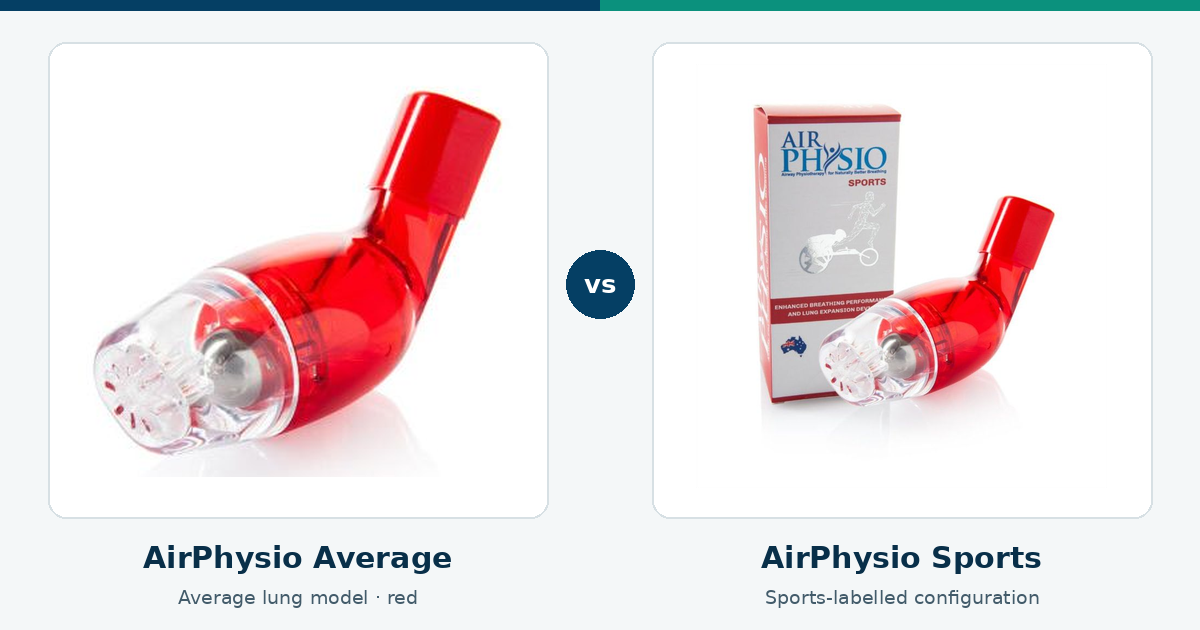
AirPhysio vs AirPhysio Sports: Quick Verdict. My default choice is the appropriately matched standard AirPhysio for a clinician-guided airway-clearance routine. Choose the Sports model when that exact model is recommended for your needs and its package makes sense for you. Both are exhalation-based OPEP devices; the Sports name is not a reason to assume a bigger oxygen, endurance or recovery benefit.
The AirPhysio vs AirPhysio Sport question is really about the right device configuration for your breathing routine. The manufacturer markets the Sports edition to active users, while the standard range includes configurations aimed at different users and airflow needs. A different colour or audience does not automatically establish a stronger training effect.
I compare these devices on mechanism, model fit, handling, care and ownership cost. Neither receives a clinical-performance score here. For a respiratory condition or a specific training goal, start with the recommendation of the clinician or qualified professional who knows what you are trying to achieve.
Standard AirPhysio: the practical baseline

The standard design places a steel ball on a cone inside a small hand-held body. Breathing out moves the ball, combining back pressure with oscillations. There is no charging routine, app pairing or powered motor. That simplicity is the strongest reason to shortlist it.
Model selection still matters. AirPhysio’s user guide describes different balls for different airflow needs. A device intended for a healthy active adult is not automatically the right configuration for a child or someone who cannot comfortably move that ball. Ask which exact device and ball to buy instead of ordering whichever listing is cheapest.
I find the compact format easy to keep with everyday belongings. That is a useful handling advantage, but it does not establish how much a particular person’s lung function will change. My AirPhysio review covers the standard design and the buying trade-offs in more detail.
AirPhysio Sports: the package and its buying fit
The current manufacturer Sports page identifies Sports branding, but body colour alone no longer identifies the variant: the current Average model listing also uses red. It is still an OPEP device built around exhalation through a ball-based mechanism. It is not a powered oxygen supply or a conventional inspiratory trainer simply because it is marketed to athletes.
If a professional recommends Sports for you, confirm the exact supplied configuration and the accompanying instructions. A bundle containing several differently named AirPhysio devices can make a price comparison misleading: make sure you are comparing the named Sports package and its supplied resistance options with the intended Average model.
For an active user, portability and a straightforward routine are meaningful advantages. I would choose the Sports edition for a clear model-specific reason, not because the word “Sports” promises a faster run, higher oxygen uptake or a quicker recovery. Those are different performance questions from whether a device is small and convenient to use.
Match the device to the job
OPEP acts during exhalation.
Match the exact model, ball and technique to the recommended routine.
Resistance during inhalation is a different training job.
Do not identify an OPEP device as an inspiratory trainer.
Endurance and recovery are separate outcomes.
Choose training and equipment for the specific goal, rather than the device colour.
This boundary is easy to miss in product advertising. Airway clearance, inspiratory muscle training and athletic performance are not three interchangeable names for the same task. For a comparison with another airway-clearance design, see AirPhysio vs Acapella.
Resistance and technique
A ball-based OPEP device responds to the airflow through it and the angle at which it is held. A heavier-feeling or harder-to-move configuration is not automatically better. If you cannot use it comfortably, the relevant question is whether the model or technique is appropriate, not whether you should push harder.
The manufacturer’s guide explains the position and breathing technique for its devices. Learn that routine for your particular model, and follow the schedule recommended for you. These devices do not supply medicine, so using one is not a reason to stop an inhaler, nebuliser or other prescribed treatment.
I would not pay a premium on the assumption that Sports provides a numbered resistance dial or a measured step-up in training load. Buy the actual supplied ball-based device and its stated configuration. If you need adjustable resistance for a different breathing task, compare a product designed for that task.
Comfort, portability and daily ownership
Both formats keep the practical attraction of a small non-powered device. They are easy to store compared with equipment requiring a power supply, and there is no app subscription to activate the basic mechanism. The time commitment comes from technique and care rather than charging or software maintenance.
A useful purchase is one you can handle, clean and keep complete. Think about where you will use it, how you will store the loose parts when cleaning, and whether you need a separate device for another household member. Do not share a respiratory device as if it were a communal fitness accessory.
A sports bag is convenient for transport, but it is not a substitute for protecting a clean, dry device. Keep it away from dirty kit, check that the parts are secure before use and follow the supplied storage guidance.
Cleaning and replacement parts
AirPhysio’s mechanism contains the body, cone and steel ball. It does not call for a routine disposable filter replacement every few months. Plan instead for the washing, rinsing and drying set out in the manufacturer’s instructions, and reassemble the correct parts.
Do not turn that simple mechanism into a “maintenance-free” claim. Soap residue, trapped moisture, a missing cone or a damaged cover can affect daily use. If a part is damaged or lost, ask the manufacturer about the correct replacement for your exact model rather than mixing pieces from a different variant.
The manufacturer gives the device an expected service life, but condition and the supplied instructions remain important. Check the warranty and replacement guidance on the product you order; a lifespan estimate is not a promise that every device will remain suitable indefinitely.
Price and value: compare like for like
Check whether the advertised price is for one device, a multi-device pack or a bundle with different models. Then compare delivery, taxes, the supplied configuration and the rules for opened returns. An introductory discount is useful only if it applies to the product and market you need.
Sports is not automatically better value because it sounds more specialised. Standard is not automatically better because one retailer’s headline price is lower. The better purchase is the appropriate model with clear contents, instructions and seller terms.
For a device bought through a retailer, use that retailer’s actual return conditions. Do not combine a manufacturer’s guarantee with a different seller’s return window or assume a used respiratory product qualifies for a refund. Keep your order details and the exact model name.
Current models: red is no longer the deciding clue
The manufacturer’s Average Lung Capacity listing now identifies red as the standard body colour, replacing teal. The existing blue device photograph shows the earlier appearance, not a rule that every standard device must be blue. When a shop mixes photographs from different production periods, the model name and supplied resistance configuration are more useful than matching a colour.
The current Better Breathing Sport listing, SKU BBSREN, describes high and medium resistance options. The Average listing describes medium resistance. This is a real package distinction, but it does not turn either product into an electronically controlled trainer, oxygen source or a calibrated numbered training programme.
Before ordering, ask whether the selected package includes both stated resistance options and which instructions apply. Check the actual order description rather than assuming that every item sold as “Sports” has the same contents across retailers and years.
Price the complete configuration, not the colour
On the manufacturer’s US-dollar product pages checked on 27 October 2026, Average was listed at US$66.99 and Better Breathing Sport at US$73.99, before any checkout delivery or tax. That makes the listed device-price difference US$7.00. It is a comparison of those two offers, not a universal premium across every retailer or country.
| Exact listing | Stated resistance | Listed price | Buying question |
|---|---|---|---|
| Average Lung Capacity | Medium | US$66.99 | Does this configuration meet the recommended need? |
| Better Breathing Sport BBSREN | High and medium | US$73.99 | Are both supplied options useful to you? |
If you need only the appropriate medium configuration, an unused additional option has little practical value. If you have a supported reason for both options, the package difference is worth evaluating. Neither the price premium nor the product name tells you to use the harder configuration.
AirPhysio also lists replacement or additional balls for Sports, Average and Low Lung configurations at a listed US$9.99. That page describes changing ball options within the product family. For an existing owner, ask the manufacturer whether the specified part is suitable for the exact body and version before buying a second complete device. The correct replacement is different from substituting a random bearing that appears to fit.
When keeping the existing device makes more sense
If the current device is complete, serviceable and appropriate for your routine, a change of body colour is not a useful upgrade by itself. Identify the problem first: an unsuitable resistance configuration, a lost component, damage or a care routine you cannot manage. Those problems have different solutions.
A replacement ball may address an appropriate configuration change, while a damaged body requires model-specific support. A second complete device can make sense when another person needs their own device, but it is not necessary merely to own two colours. Keep respiratory equipment personal rather than sharing it as a piece of gym kit.
For a training goal, decide whether you need airway clearance or a separate inspiratory training programme. Record the goal and ask what benefit the selected equipment is expected to provide. A stronger sensation while exhaling is not a measurement of endurance, oxygen delivery or recovery time.
My standard-model recommendation is therefore conditional on correct fit and configuration, not on standard always being cheaper or medically superior. Sports is a reasonable package to consider when its actual included options solve a need. If they do not, keep the purchase simpler and put the effort into correct use and care.
My recommendation
Choose the correctly configured standard AirPhysio as the default for an appropriate airway-clearance routine. Choose Sports when you have a concrete reason to select that exact model, rather than an expectation of automatic athletic gains. The important advantages are a suitable mechanism and a manageable ownership routine.
If your goal is performance training, first identify the kind of training you need. If your goal is managing a respiratory condition, the model and technique recommended by your clinician are the deciding factors. In either case, a generic “better breathing” promise is too broad to choose your equipment.
Frequently asked questions
What differs between standard AirPhysio and the Sports version?
The current Sports package lists high and medium resistance, while Average lists medium. Both use exhalation-based OPEP; the current Average device is also red, so check the model and package rather than colour. These specifications do not guarantee athletic or clinical gains.
Where should I compare AirPhysio prices?
Compare the exact device and bundle at the manufacturer and reputable retailers, including delivery, taxes and opened-product return terms. A multi-device pack is not the same purchase as one device.
Can athletes use AirPhysio Sports?
It is marketed to active users, but suitability and expected benefit depend on the person and goal. It is not a substitute for a training plan or an inspiratory trainer.
How should AirPhysio Sports be used?
Follow the supplied model instructions and the routine recommended for you. The mechanism works during exhalation; positioning and appropriate airflow matter.
Should medical advice guide an AirPhysio purchase?
Yes, particularly for a respiratory condition or an airway-clearance routine. Ask which exact model and technique are appropriate rather than treating a brand-wide claim as a prescription.
What if I cannot comfortably move the ball?
Ask about the appropriate configuration and technique. The manufacturer describes lower-resistance options for some users; do not assume the Sports model or a harder-to-move ball is the right next step.
Related Posts
Share this article

Stuart Kerr Spindlow is Pixoneye’s Publisher, Editor-in-Chief and Lead Product Reviewer. He tests consumer products and leads coverage of practical gadgets and personal-media preservation. His reviews focus on usability, limitations, value and the trade-offs that matter when choosing a product. Read Stuart’s full profile.
Leave a Reply