
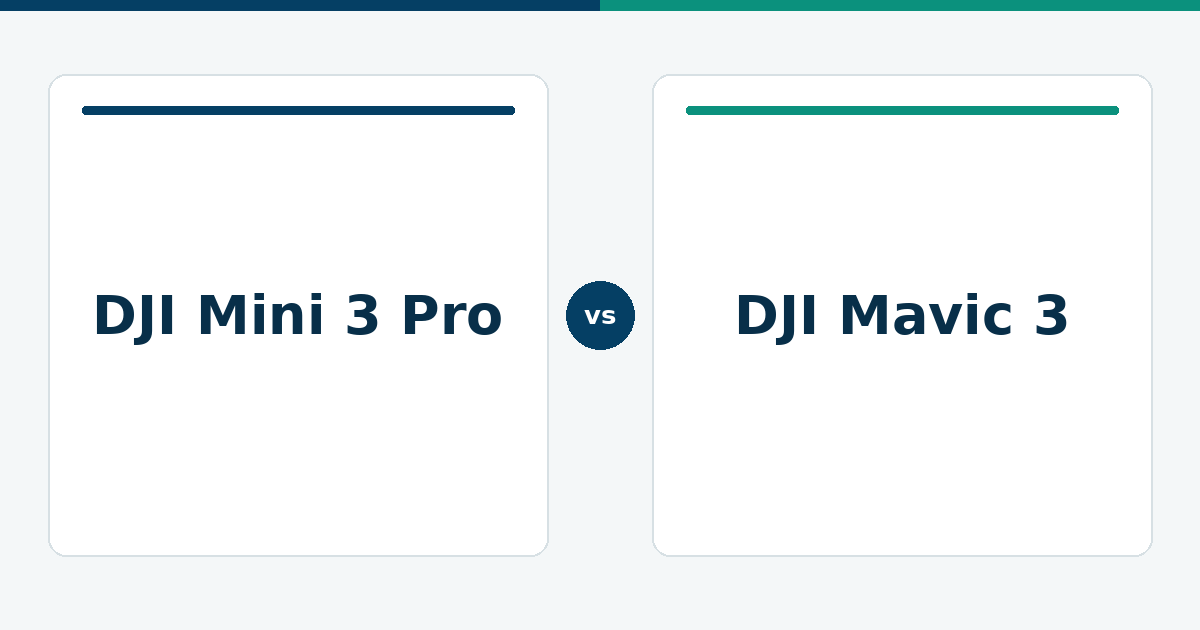
Quick verdict. I would choose Mini 3 Pro for compact carrying and true vertical shooting; the original Mavic 3 for its 4/3 main camera and additional tele camera. This is not Mavic 3 Pro, and Cine recording features should not be assigned to every Mavic 3 kit.
These models serve different camera and packing priorities. Start with the photographs and video you want, then compare the actual aircraft, battery and controller offer. A professional label or higher price does not establish the better tool for every use.
Keep the Mavic variants separate
| Buying detail | DJI Mini 3 Pro | DJI Mavic 3 |
|---|---|---|
| Camera | 1/1.3-inch;12/48 MP modes | 4/3 main 20 MP plus separate tele camera |
| Lens/portrait | Fixed f/1.7;true vertical shooting | Main f/2.8–f/11;landscape-based framing |
| Main headline video | 4K/60 | 5.1K/50 in supported main-camera mode |
| Standard aircraft | Under 249 g | 895 g;Cine 899 g |
| Maker flight maximum | 34 minutes standard;47with Plus | 46 minutes |
| Sensing | Forward, backward, downward | Omnidirectional, with limits |
Choose the sensor and focal-length workflow
Original Mavic 3 has a 4/3-format 20 MP main camera and a separate tele camera. It is not the triple-camera Mavic 3 Pro. The main lens offers adjustable aperture, giving another exposure control; Mini 3 Pro’s camera uses fixed f/1.7.
Mini 3 Pro offers 12 MP and 48 MP still modes. A higher pixel count does not by itself outweigh the larger sensor format, lens behaviour or exposure options of another camera. Compare an original file for your actual lighting and editing needs.
The extra tele camera can change a composition while keeping the aircraft in an appropriate position. Check its own supported modes rather than applying the main camera’s recording specification to it.

Mini’s rotating camera changes portrait capture
Mini 3 Pro rotates its camera for true vertical recording. That helps when a portrait output would otherwise require a landscape crop that cuts out important subjects. Mavic 3’s higher-resolution landscape recording is a different advantage.
Check the resolution, frame rate, colour profile and codec together. The ProRes and 1TB internal-storage workflow belongs to Mavic 3 Cine, rather than every original Mavic 3 package.
Choose a recording mode your editor handles reliably and keep the original files outside the flight app. More demanding files are useful when they improve the project, not simply because a specification is larger.

Compare complete carrying and battery configurations
Mini 3 Pro has a much smaller standard aircraft. Include its controller, charger and spares in the bag comparison, however, rather than treating the airframe weight as the entire carrying load.
DJI specifies up to 46 minutes for original Mavic 3 and 34/47 minutes for Mini 3 Pro depending on battery, under stated tests. Mini’s Plus battery changes weight and market availability; do not combine that time with the standard sub 249 g configuration.
Battery age, wind, hovering, movement and a return reserve change useful working time. None of these published figures guarantees a shooting session or authorises a long-distance endurance demonstration.
Sensing and legal categories still have boundaries
Mavic 3 has omnidirectional sensing, while Mini 3 Pro senses forward, backward and downward. Mini lacks side coverage. Both have environmental and mode limits; neither is collision-proof.
Use tracking and automatic camera moves only on a checked route and within their documented operating conditions. An assistance system is not permission to fly close to people or through an obstructed scene.
Country, configuration, location and use determine applicable requirements. A small aircraft is not universally unregulated, and a consumer camera drone is not automatically a validated mapping or inspection system. Choose suitable equipment and expertise for those specialist tasks.
Check the actual control setup and older-kit condition
Both are DJI Fly aircraft, but exact controller and firmware compatibility still matter. A screen controller shown in a review is not proof that it is included in the seller’s kit.
Check account transfer where applicable, battery condition, arms, propellers, gimbal, card recording and live view. Compare current seller-specific returns, repair support and accessory availability.
For the newer triple-camera question, see Mavic 3 Pro versus Mini 3 Pro. For a main-camera-only Mavic option, see Pro versus Classic.
Value, ownership and my final choice
I prefer Mini 3 Pro when its portrait capability and smaller kit make the most difference to everyday use. I would choose original Mavic 3 for a deliberate larger-main-camera and telephoto workflow when the complete older kit is worth its cost.
Do not base the decision on launch prices, promised future features or invented user-star averages. The better buy is a demonstrably working configuration that produces the files you need and suits the operation.
Frequently asked questions
Is original Mavic 3 the same as Mavic 3 Pro?
No. Original Mavic 3 has a main and tele camera; Pro has three recording cameras.
Which suits a small travel kit?
I generally prefer Mini 3 Pro when its output is sufficient, particularly for portrait content.
Does Mavic 3 always fly longer?
Not compared with every Mini battery configuration. Maker maxima are 46 minutes for Mavic 3 and 34/47for Mini 3 Pro, with conditions.
Does Mini’s low weight remove requirements everywhere?
No. Check country, configuration and use; Plus batteries and accessories can change its weight.
Which has the larger main sensor?
Original Mavic 3 uses a 4/3 main sensor; Mini 3 Pro uses 1/1.3-inch.
Does either always avoid obstacles?
No. Their sensing coverage differs and both have operating limits.
Sources and image credits
DJI Mavic 3 specifications; DJI Mini 3 Pro specifications.
Related Posts
Share this article

Stuart Kerr Spindlow is Pixoneye’s Publisher, Editor-in-Chief and Lead Product Reviewer. He tests consumer products and leads coverage of practical gadgets and personal-media preservation. His reviews focus on usability, limitations, value and the trade-offs that matter when choosing a product. Read Stuart’s full profile.
Leave a Reply