
Comparison: Quick Verdict. My preference between the original Audien Atom and original Atom Pro remains the Atom for simpler everyday handling and value, when the exact older model is suitable and properly supported. The Pro’s smaller body and portable charging case suit a different priority. Neither name should be confused with Atom ONE, Atom 2 or Atom Pro 2. For a new purchase, confirm the model, current package and hearing-health suitability before choosing by price.
Audien Atom vs Atom Pro is most useful when the names refer to the same generation. This comparison covers the original two devices in our existing coverage, including the practical handling and listening impressions reported here. Audien now offers a wider range, so a current “Pro” search result can describe different hardware.
The decision is about more than a discreet appearance. Can you insert and remove the device comfortably, change its settings, manage the charger and obtain the correct replacement domes? Does it help in the situations that matter to you? A smaller housing or a premium-sounding name does not answer those questions.
First, separate the original devices from later Audien models
Audien’s current support and product navigation identifies Atom ONE and Atom Pro 2 alongside other models. Atom Pro 2 is not the original Atom Pro, and a current Atom ONE offer should not automatically be described as the original Atom. Check the label on the box, manual and order confirmation, including the generation number.
That distinction matters for controls, charging, listening modes, cleaning features, accessories and price. A later model may have features absent from these earlier units. Likewise, a criticism of the original Pro should not be carried into a Pro 2 review as if the hardware and listening experience were identical.
For an existing owner, use the documentation for the device actually in your hand. For an old-stock purchase, ask the seller to identify it in writing and establish the support and return arrangement. Do not assume that a link with a familiar product name necessarily leads to the same package described in a historical review.
Original Atom vs original Atom Pro at a glance
| Practical question | Original Atom | Original Atom Pro |
|---|---|---|
| Why consider it? | Simpler value-oriented starting point in this comparison | Smaller housing and a portable charging case |
| Handling priority | Check removal wire, dome fit and access to controls | Check whether the small controls and housing suit your dexterity |
| Charging task | Use its matching charging equipment | Manage both the hearing devices and the charging case |
| Listening judgement | I preferred its practical everyday use in our coverage | Its noise handling was less helpful to me than the “Pro” name suggested |
| What does not follow? | No guarantee of clear speech in every noisy setting | Smaller does not mean a better fit for every ear |
| Before buying now | Confirm original model versus Atom ONE/Atom 2 | Confirm original Pro versus Pro 2 |
| Health category | Read the actual device labelling; US OTC hearing aids are for adults 18+ with perceived mild-to-moderate hearing loss | |
Who is an over-the-counter hearing aid for?
The FDA’s OTC guidance describes the US category for adults aged 18 and over with perceived mild-to-moderate hearing loss. Buying without a prescription is possible in that category, but it does not mean an examination is pointless or that every online sound-amplifying device belongs to the category.
Read the actual packaging and intended use. Hearing aids and personal sound-amplification products are not interchangeable categories simply because both make sounds louder. An old listing’s use of “amplifier” or “hearing aid” should not substitute for the label on the item you receive.
The FDA also explains when professional assessment is useful. Children, more severe hearing loss and complex needs require a different pathway. Adults can still choose a hearing evaluation to understand the type and extent of loss before deciding on an OTC product.
If your difficulty is substantial even in a quiet conversation, do not assume that the most powerful-looking online package is the right answer. A hearing-care professional can help assess needs and options. Affordability matters, but an inexpensive device that does not address the problem is not good value.
Handling and fit: why I lean towards the original Atom


The original Atom’s discreet in-ear design and removal wire were useful practical features in our coverage. The point is controlled removal, not pulling abruptly on a device in the ear. Check that you can locate the wire, grip the housing and follow the instructions without strain.
My concern with the original Pro was its small size and fine volume adjustment. A compact housing can look more discreet while being harder to manipulate or find if dropped. That is especially relevant to anyone with limited dexterity or vision, rather than a problem that should be generalised to everyone of a particular age.
Dome fit matters at least as much as the outside dimensions. A smaller body does not establish that it belongs in a narrower ear canal, and a loose fit is not solved by pushing the device farther in. Use the supplied sizes as instructed, and ask support or a hearing professional when comfort, retention or feedback remains a problem.
If you are helping a relative choose, let the intended wearer handle the controls and charger. Being able to insert a device once while someone assists is different from managing it comfortably every day. Consider the whole routine, including removing it before washing and finding a safe storage place.
What the original Pro’s case changes


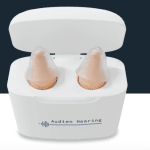
The manufacturer’s original Atom Pro guide describes tool-adjusted volume and a charging case. It explains that the devices power off and charge when placed in the case, and that the charged case supplies additional charging cycles. This is a different ownership task from simply plugging in the hearing devices.
Portable charging can be useful for travel or a long period away from a socket. It is less valuable if the case itself is left uncharged or the devices are not seated correctly. Check the indicators and the actual charge state of each part before leaving home.
Separate device runtime from the reserve stored in a case. “Hours per charge”, extra recharges and total case-supported use describe different things. Do not add them together as if the devices run continuously without being returned to the case, and do not transfer a newer model’s advertised battery life to the original Pro.
Wireless charging also does not establish Bluetooth music streaming or phone-call connectivity. Confirm those features explicitly for the exact model if they matter to you. A hearing device can use a wireless charging arrangement without acting as a wireless headset.
Listening quality and background sound

In our existing listening experience, I preferred the original Atom overall and found the original Pro’s noise handling less helpful than its upgraded name suggested. That qualitative judgement remains part of the comparison. It should not be turned into a claim that every Pro has no noise reduction or that the Atom removes all background sound.
The FDA’s benefits-and-limitations guidance is a useful expectation check: hearing aids do not restore normal hearing, and unwanted sounds can still be amplified. Listening conditions and settings matter. A device that seems useful at home may require a different judgement in a restaurant or group conversation.
Test the situations that matter during the seller’s return period, at a comfortable level and using the device instructions. Keep notes on speech understanding, comfort and practical difficulties so you can ask for specific help. Do not respond to disappointing clarity simply by continually raising volume.
Adaptation and troubleshooting can help, but ongoing pain or a concerning change in hearing should not be dismissed as a normal adjustment. A fitting issue, blocked sound outlet or unsuitable device deserves a proper answer. The goal is usable communication, not persevering with a purchase at any cost.
A decision diagram for the complete daily routine
Health or suitability concern?
Assessment first → choose an appropriate category and support pathway.
Do not decide by housing size or price alone.
Simple home routine
Compare control access, dome fit and the matching charger.
Original Atom is my practical value preference between these two.
Portable charging matters
Compare the original Pro’s case benefit with the smaller-device handling task.
Check exact generation; Pro 2 is a separate product.
Care, wax guards and charging problems

Ear domes and wax guards are consumable parts of the ownership routine. Use the correct replacements for the model and follow the supplied method. Do not improvise with a sharp object in the sound outlet or the ear canal, and do not assume every Audien accessory fits every generation.
Keep cleaning tools for their intended task. The original Pro guide distinguishes its brush from the volume-adjusting end of the tool. That is a practical reason to read the instructions before cleaning, rather than treating a small screwdriver-like tool as interchangeable with a brush.
If there is no sound, check the obvious supported steps: charge state, proper seating in the charger, the selected setting and the model’s cleaning guidance. If the issue remains, contact support with the exact model and what you observed. Do not dismantle a rechargeable device or keep charging one that is damaged or unusually hot.
A charging case or a cleaning feature is not a reason to immerse hearing devices. Keep them away from bathing, swimming and household cleaning chemicals unless the exact product’s instructions expressly permit a use. Store the small parts safely away from children and pets.
Current prices, packages and return terms
The useful price comparison is the final cost of the exact pair you can buy, including its charger, domes, delivery and any paid protection or subscription. A historical $99 Atom package and $242 Pro listing are not a current like-for-like quote, especially if a seller now offers a different generation under a shortened name.
Check whether the price is for one device or a pair and whether the charging equipment is included. A lower headline price can be less attractive if required accessories or replacement parts are missing. For old stock, confirm who will provide support and whether the original battery condition is acceptable.
Audien currently advertises a 45-day trial on its US site, but the applicable order and seller terms still matter. Before paying, establish when the period starts, how to request a return, which costs are excluded and how refunds are handled. Keep those terms and the receipt rather than relying on a review’s old guarantee wording.
A manufacturer, an authorised retailer and a marketplace seller may have different support and return arrangements. Check the seller rather than assuming all marketplace inventory is counterfeit or that every brand-looking landing page is the manufacturer’s site. Authenticity and a usable return process matter more than an urgency banner.
Insurance, FSA and HSA payment are separate questions. Check your plan or account rules and the product’s eligibility before assuming reimbursement. Do not interpret a payment logo as a promise that every privately insured buyer is covered, or that every account will accept an identical claim.
How much weight should customer ratings carry?
Customer feedback can help identify patterns around comfort, controls, delivery and returns. It should not be reduced to two identical old star averages and treated as a clinical tie. Review date, exact generation, seller and the number of reports all affect how useful the information is.
A review of Atom Pro 2 does not validate a statement about original Pro noise handling. Likewise, a professional organisation discussing one Audien model has not necessarily endorsed the whole range. Read the specific product assessment rather than treating an organisation’s name as a blanket recommendation.
Our handling and listening preferences are editorial judgements based on the experience in this coverage. They are not a measured battery rundown, speech-recognition score or clinical comparison. A buyer’s own safe, properly supported evaluation can reasonably lead to a different preference.
My recommendation
Between the original two devices, I retain the Atom as the simpler value choice for someone who finds it suitable and can obtain the exact supported package. The original Pro is worth considering when its smaller housing and portable case solve a practical need and the user can comfortably manage the controls.
For a new purchase today, begin with the current labelled model rather than insisting that an older review winner must be the right product. If you are considering Atom ONE or Pro 2, compare those products on their own terms. If your hearing needs or symptoms warrant assessment, start there before choosing a device.
The best value is a device that helps communication, remains comfortable and can be maintained and supported. Neither the cheapest price nor the smallest housing can guarantee that combination. Use the return period purposefully, ask for help when needed and choose an appropriate clinical pathway when a retail device is not enough.
Frequently asked questions
Is original Atom Pro the same as Atom Pro 2?
No. Keep the generation number visible when comparing controls, charging, listening features and prices. This article’s original Pro experience is not a Pro 2 test.
Who are US OTC hearing aids intended for?
Adults aged 18 and over with perceived mild-to-moderate hearing loss. Read the actual package label; children and more severe loss need a different professional pathway.
Does buying without a prescription mean I should avoid a hearing test?
No. An evaluation can help clarify the type and extent of hearing difficulty even when it is not required to buy an OTC product.
Does a smaller device guarantee a more secure fit?
No. Ear shape, dome selection and comfortable placement matter. Do not choose the Pro solely because you assume a small housing fits a narrow canal.
Does a wireless charging case mean Bluetooth streaming?
No. Charging method and wireless audio connectivity are different features. Verify streaming or call support for the exact model.
Do hearing aids remove all background noise?
No. They do not restore normal hearing, and background sound can remain. Use a comfortable level and seek support if useful speech remains difficult to understand.
Are the old $99 and $242 prices current quotes?
Treat them as historical packages, not guaranteed prices for today’s stock. Check generation, pair versus single device, charger, delivery and the actual seller’s terms.
Are hearing aids always covered by insurance, FSA or HSA?
No universal payment or reimbursement promise applies. Check your plan, account rules and the exact product’s eligibility before paying.
When should I see a doctor before buying?
Seek medical advice for sudden or rapidly changing hearing loss, pain, discharge, severe dizziness or a marked one-sided change. Follow the complete warnings on the package and FDA guidance.
Related Posts

Share this article

Stuart Kerr Spindlow is Pixoneye’s Publisher, Editor-in-Chief and Lead Product Reviewer. He tests consumer products and leads coverage of practical gadgets and personal-media preservation. His reviews focus on usability, limitations, value and the trade-offs that matter when choosing a product. Read Stuart’s full profile.
Leave a Reply